
For the last twenty years, software companies have enjoyed the most favorable economics of any businesses ever built. You wrote the code once and sold it forever to an ever-growing base of customers who couldn’t easily leave. Every once in a while you fixed some bugs, but you mostly just let the money printing machine keep doing its thing.
The model rested on a few key structural advantages, each of which AI is now demolishing. The danger to software companies isn’t (just) that demand disappears because everyone vibe codes their own to-do list app; it’s that the economics of every part of a vertical software business are suddenly dramatically worse, all at once.
Customer acquisition is more expensive because you have more competitors and they’re all trying to reach the same people you are. Serving each customer is more expensive because your dashboard suddenly needs to “do AI stuff” and doing AI stuff costs actual money. And customers stick around for less time because changing tools is as easy as asking Claude to move everything over to a new system. Or make a new system. Or ten new systems and a Systems System to keep track of them all.
The era of near-perfect gross margins is over and the revenue multiples that made software the envy of every other industry are compressing toward something that looks a lot more like a normal business.
That isn’t to say software businesses are going away. In fact, there are going to be way, way more of them, and in a lot of ways that’s an amazing and good thing. We’re on the verge of unleashing the full creative potential of everyone who ever had an idea but not the technical skills to realize it.
But if you’re trying to build a business selling software — well:

Somehow, in the year of our lord 2026, a lot of people in the tech industry haven’t fully processed that yet.
You’re Gonna Need a Bigger Moat
For a generation, the scarcity of high-quality engineering talent turned competent software development into a competitive advantage. Yes, you could theoretically outsource development to an expensive shop in SF or NY or a cheap one overseas, but companies that relied on software to acquire and serve customers and didn’t make building it a core competency usually found the results just weren’t very good.
Good software was severely supply constrained; there were virtually unlimited applications of it and very few people who could build it well. So the whole game was convincing more college kids to drop out and join your team than the next startup down the street. And there were only so many of them to go around, so everyone lost their minds and for a few strange years you had Facebook interns being paid more for a summer of writing unit tests than their parents made in a year.
Now, anyone can ship a credible product and the best builders can ship ten of them. The flood of new supply isn’t creating or destroying anybody’s moat — but a lot of celebrated software businesses are quickly discovering that their only real edge was being early and well-staffed, not being structurally hard to displace.
A simple heuristic if you’re a software company trying to figure out if you’re screwed: could Microsoft copy your product and make it 20–50% worse but give it away for free and kill your dreams of an IPO? That’s what they did with Microsoft Teams, which kneecapped Slack’s growth, leading them to sell, and allowing Microsoft to walk away with the entire enterprise market. Because Slack, at the end of the day, is a chat app.
Even the big tech companies only have so much time and so many engineers and thus can only one shot so many businesses at once (sad for them). But if they theoretically could do the same to your (very nice, I’m sure) CRM/task tracker/page builder/dashboard/tooling startup, then a teenager with a mouthful of Zyn and a Claude Max account can now too.
Good luck competing with them. They’re chronically online, on their parents’ healthcare, and happy to give a mediocre clone of your product away for free in exchange for a few internet points.
Everything Is Easier and Harder at the Same Time
Building a technology company has always meant solving two problems at once: the domain problem and the software problem. The domain problem is the actual pain you’re trying to solve in the market. It’s the thing your founder expounds on in the mission section of your company handbook. It’s what you tell people about when they ask how you’re making the world a better place.

The software problem is the literal challenge of writing down millions of the right words in the right order such that 1s and 0s can flow through a massively interconnected global information network to make an actual, useful thing happen in the real world. And until recently, the software problem was often the one companies spent more time and resources on, mission statement notwithstanding, because it was the harder problem.
No longer. Over the last year, the software problem has been (mostly) solved for (nearly) all companies at (basically) the same time, thanks to AI.
For everyone with an entrepreneurial bent who’s not a software engineer or SaaS startup founder, this is amazing news. That idea you had because you have unique insight in the industry you’ve worked in for ten years but had no idea how to build a software business around? Congratulations, the door to founderhood just swung wide open to you. If you build infrastructure or hardware or marketplaces you can suddenly pour all of your resources into your domain problem. If you are an artist or creator with an audience you can suddenly build a much larger, more profitable and category-spanning business.
But if your company is pure application software, there’s no “other thing” to retreat to. The code was the product, and now the code is the easy part. Without something harder underneath — a physical system, a regulatory maze, a network that compounds — you’re left competing in a market with roughly everyone on the planet who has access to a computer.
What Survives
In a world where code is no longer a scarce resource, there are really only a few things for a software company to do:
Lean into network effects. Products that get better as more people use them have a defense that doesn’t depend on code at all. Meta Ads has the product discipline of the DMV online portal and still prints money because, well, where else are you gonna buy ads?
Become a heat shield. Some businesses exist so their customers don’t have to deal with the worst parts of operating in a regulated, high-stakes, or bureaucratically insane environment. The customer isn’t buying software — they’re buying the outcome of not having to think about it. There are at least two flavors of this:
Risk arbitrage: you take on actual liability — compliance exposure, financial risk, regulatory burden — so the customer doesn’t carry it.
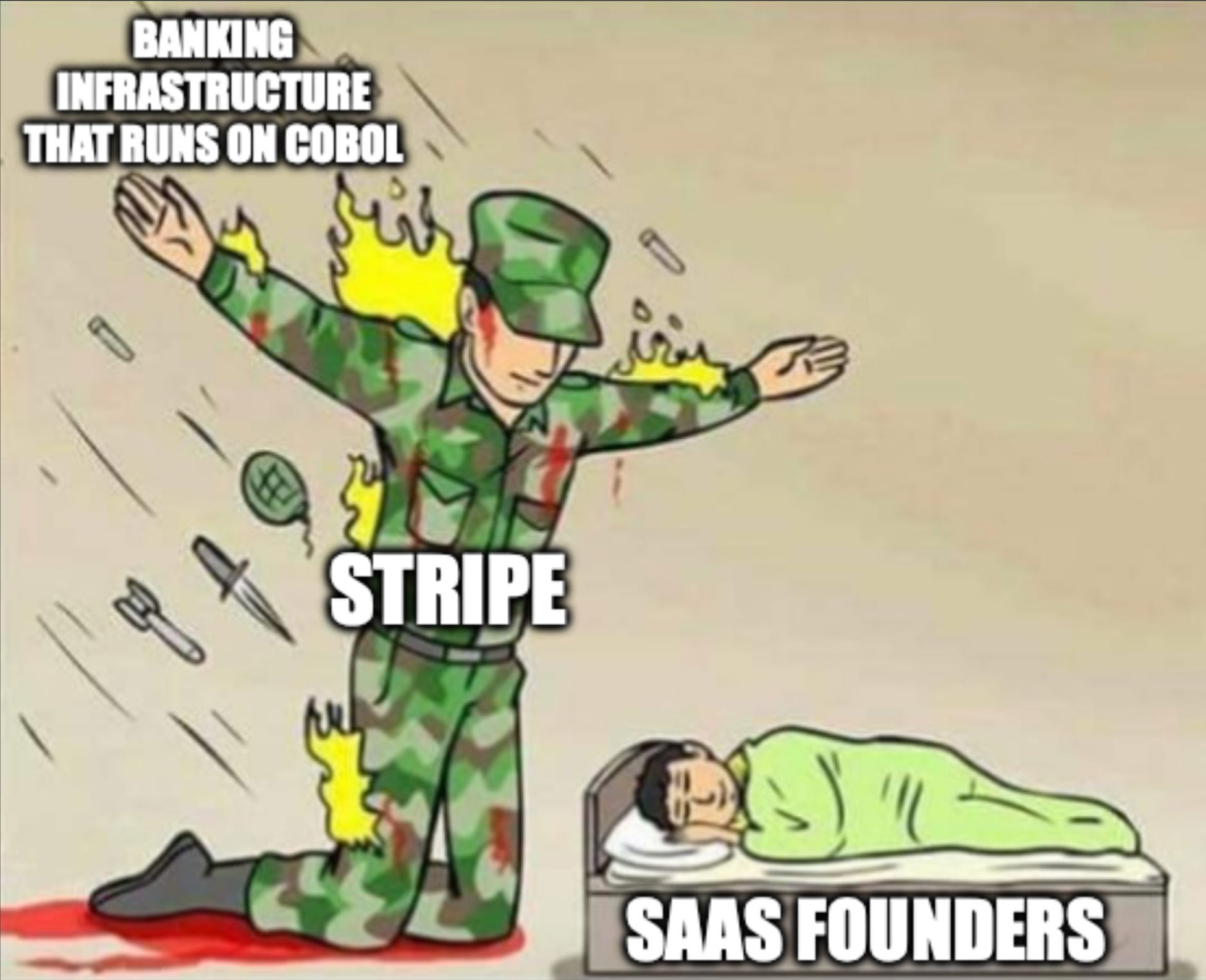
Complexity absorber: you navigate or abstract away a labyrinthine real-world system on your customer’s behalf so they can focus on what they’re actually good at. No startup founder has ever woken up excited to understand PCI compliance, and thanks to Stripe they don’t have to.
Healthcare, finance, security, infrastructure — these categories have a future precisely because the hard part was never writing the application. You can’t vibe code FDA regulatory compliance any more than you can vibe code Stripe, because the product isn’t the code — it’s shielding you from the byzantine system on the other side of it.
At the same time, entirely new models for software-enabled companies are suddenly possible. Among them:
Go bigger. Well-capitalized software companies can chase larger markets and bigger contracts by accepting messier operations, thicker cost structures, and thinner margins. Adding services builds trust and creates dependencies that are harder to dislodge than product alone. It’s less scalable but much more defensible in a world where code is ~free.
Go smaller. Tiny AI-native teams can run shockingly profitable operations that even become venture-scale outcomes. These teams start with direct client relationships and build product to transform their margins. They begin operating at ~services economics but with rapid experimentation and automation they can systematically bend the P&L toward software economics.
Put another way, you’re going to see software companies start to look more like services companies, and you’re going to see services companies start to look more like software companies.
In 2012, Ted Sarandos, the CEO of Netflix, famously said his goal was to “become HBO faster than HBO can become us.” The question now for software companies and service providers is who can fill in the gaps faster and maintain the more defensible position.
Small agencies are stringing together workflows with Claude Code or partnering with indie devs to scale two-person teams from one, to five, to ten, to fifty clients. SaaS platforms are trying to close the loop and deliver a fuller offering with AI. Who gets there first and what does the resulting business look like?
Well, the SaaS company going full stack is trying to convince the customers on their $20/mo tier to bump up to $100/mo in exchange for some AI credits they have to subsidize at a loss. Meanwhile, AI-pilled consultants already have product-market fit selling the thing the customer actually needs: a trusted authority that tells them It’s Handled for $20k/mo.
Each has its challenges. But if you’re a bright-eyed young founder, you have to ask yourself: which business do you want to be building?
May You Live In Interesting Times
The irony of this all is that right at the moment that software got exponentially better, the business model around it got radically worse. Software can do things now that used to require entire departments. It’s more powerful and more useful than it’s ever been. It’s just a terrible product to sell on its own.
But, in a way, that’s freeing. Because now we all get to focus on solving real problems, not software puzzles. Just think: nobody in the future will need to know how to use Asana.